“My Week at the Full Armor Lectures” by Jeremy Marshall Day 2 (pt. 4)

“My Week at the Full Armor Lectures” by Jeremy Marshall
Day 2 (pt. 4)

from part 4:
“Just look at the logo on the dust jacket. This book was published by the once-sound, now apostate Harlan Publishing House. Let me give you a brief list of titles, so you can see what other heretics they are harboring. They’ve put out My Mama Sang Tenor, Too by the weepy story-teller Buddy Silver. They published the downright odd volume,Jesus and the Art of Volkswagen Repair by the so-called “Hippie Preacher,” Archie Klein. And they also released an awful book called Lessons I’ve Learned About Christian Living From Playing Texas Hold ‘Em, by Francis Spicoli. That Harlan Publishing released this book from Brother Jones is very telling–it means that none of our faithful publishing companies like Banner of Love or Full Armor Press will touch it with a thirty-foot pole!”
 

“My Week at the Full Armor Lectures” by Jeremy Marshall Day 2 (pt. 3)

“My Week at the Full Armor Lectures” by Jeremy Marshall
Day 2
 part 3:

“Good Brother Mack was shaving the other Sunday morning, and he cut himself several times. I mean he tore his face smooth up! And when he came downstairs for breakfast with several hanks of toilet tissue on his face, his wife asked him how come he’d cut his face all up. He told her he’d been distracted–thinking about his sermon more than he was about shaving. So his wife told him he might ought to think about shaving his sermons!”

“My Week at the Full Armor Lectures” by Jeremy Marshall Day 2 (pt.2)

My Week at the Full Armor Lectures” by Jeremy Marshall
 Day 2 part 2:

“After a wholesome and patently uninteresting luch at a nearby Picadilly cafeteria, I arrived back at the Doogood Ave. building about half an hour before Brother Mack Snipes’ lecture, “Hell is ETERNAL,” was slated to begin. I checked the lectureship schedule, and saw that the session was to be held in room 17 of the children’s wing. It turned out to be a classroom for five-and-six-year-olds.”

“My Week at the Full Armor Lectures” by Jeremy Marshall continues with Day 2 (pt.1)

The week continues with day two, in which we scrutinize hymns.

“My Week at the Full Armor Lectures: Day 2”  Part 1
by Jeremy Marshal

From Day 2 part 1:
I told him I wasn’t rebuking anyone. “Besides,” I said, “wouldn’t he have to be here at the table with us to qualify it as me rebuking him? I just want to know why we can’t sing ‘Just as I Am.’”

“I’ll tell you why we can’t sing that song,” croaked the man with the hearing aid who’d been shushed for “Amen”-ing the evening before. “It encourages moral laxity. You start singing a song like that and people get too comfortable with being sinners. They’ll say, ‘If it’s all the same, I’ll just go on sinning, since Jesus will take me just as I am.’”

_Blue Like Jazz_: the Book, the Film, the Thoughts

“I used to not like God because God didn’t resolve. But that was before any of this happened…Jazz is like life because it doesn’t resolve. But what if we’re not alone? What if all these stars are notes on a page of music swirling in the blue like jazz?”

I came across Donald Miller as a group at my church were studying his memoir, and then as my brother introduced me to him.  Donald Miller’s memoir of reflective essays, Blue Like Jazz: Non-Religious Thoughts on Christian Spirituality, is a book that is refreshingly honest, complexly painful, and creatively provocative.  It successfully reaches both Christians and non-Christians as an audience.
Continue reading

Electing Faithfulness Part 10: About 5 More Issues to Examine

[back to part 9: Education]

“And other issues to consider”
or
“Issues I may not care less about, but am squeezing together for time’s sake”
or
“Ok, Caleb Coy, let’s hurry up and wrap this thing up—I gotta vote in like 3 days.”

So, remember how I’ve been going on about Ron Paul because I’m writing his name in even though he’s not running?  In this post I will get into things I disagree with him on, or am unsure about.  This post will also cover other issues I have yet to mention.  After this, I plan on having a final post to reflect on the whole experience before we all go and jump in those booths.  It may be that I have a post after that to reflect on the results, and I already know that no matter what I will be reminding us all not to panic, because Christ will still be King when it’s all over.
Continue reading

_Not Worth Fighting For_ Review: Part 13

Chapter 12 was on the alleged violent Jesus in the temple.

Chapter 13 is about the alleged violent Jesus in John’s Revelation.  J. Nelson Kraybill asks “What About the Warrior Jesus in Revelation 19: ‘He has trampled out the vintage’?”

To start with, Kraybill reminds us that “we should read Revelation as reassurance that God has chosen to act and redeem in the midst of a messed up world.”  That’s important, considering some of the weird interpretations of the book that have come up over the ages.  Far too many people still believe that it’s something like the “Left Behind” books that themselves left wisdom and truth behind.  What John writes is in essence a revealing.  In all the troubles Christians were undergoing and about to undergo, we Jesus is revealed.  That is the purpose of the book John wrote on Patmos.
Continue reading

_Not Worth Fighting For_ Review: Part 12

The last chapter dealt with the centurion.  This chapter deals with the temple incident.

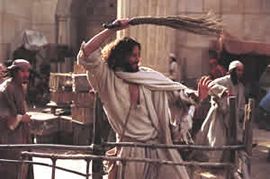
John Dear in Chapter 12 asks, “Didn’t Jesus overturn the tables and chase people out of the temple with a whip?”

Most of the paintings of this incident were done after versions of the Bible were disseminated that translated the word as “whip”.  Like paintings of a white Jesus, sometimes these old images continue through a culture, regardless of what a text says.

However, Dear makes it clear that this incident reminds us that “the nonviolent Jesus was not passive.  He did not sit under a tree and practice his breathing.”  Jesus was very confrontational, and may have seemed angry enough to hit someone or more.  It’s no wonder we may think his actions at the temple prove he wasn’t nonviolent because it was so…action-oriented.  “His nonviolence was active, provocative, public, daring and dangerous.”
Continue reading

_Not Worth Fighting For_ Review: Part 10

The last chapter dealt with what it meant for “every soul to be subject to governing authorities“.

Chapter 10 Samuel Wells deals with a puzzling statement made by Jesus.  Now we ask, “Didn’t Jesus say he came not to bring peace, but a sword?”

Matt. 10:34-39 is the central text in this chapter.  Jesus did in fact say these words: “I have not come to bring peace, but a sword.”

The irony Wells points out is that nearly every Christian will tell you Jesus didn’t “come to bring the sword”, and yet so many Christians act as if he did, whereas he said he did “come to bring the sword”, and yet his life and the lives of his followers after his ascension show the opposite.  So something’s strange here, right?

Continue reading