Spelling question:
When do you use “naked” and when do you use “nekked”?
It’s simple, really.
Naked is when you have no clothes on.
Nekked is when you have no clothes on, and you’re up to something.
Spelling question:
When do you use “naked” and when do you use “nekked”?
It’s simple, really.
Naked is when you have no clothes on.
Nekked is when you have no clothes on, and you’re up to something.
College is starting back. Some of you will be going for the first time. You will meet new people. Some of you are going to a Christian college, one in the south, like I did. How well do you know your Christian College stereotypes? Based on the famous “99% of the People You Meet in College” article (from which I shamelessly plaigiarized), I give you a list of possible stereotypes you may encounter at a particularly Christian university in the south:
[This list is meant to make fun of stereotypes, so if you’re offended because you think one of these describes you, this blog may not be suitable for your consumption.]
Continue reading
[This week we’ll be saying goodbye to summer with three summer-themed poems I wrote during the summer. This untitled poem I wrote last summer, shortly after the birth of my son.]
Down in the hemlocks
I brought my young baby
My boy in a blanket
And swaddled him there
Under the hemlocks
Down by the river
The cold stony river
Under the shade
.
[For Noah]
[This week we’ll be saying goodbye to summer with three summer-themed poems I wrote during the summer. This first number, based on my fishing trip, is a parody of “The Rime of the Ancient Mariner” by Samuel Taylor Coleridge.]
The Rime of the Anglyng Touryst
by Caleb Coy
It is an angling Tourist,
And he renteth a cheap rod.
“I’ve cut my shrimp in quarters.
Will I catch me a cod?”
Optimistic as the rising sun,
He casts out with a wink
(Because it’s all in the wrist,
Or so he’s been told to think).
He feels a little wiggle
He feels a little pull
“I think I’ve got a live one!
I’ve yanked him from the shoal!”
Alas, on pillars snagged—
It appears that when he cast
A wave brought his line inward
To the pier the hook held fast!
He gives a friendly wave
To a stranger down the pier,
Who knows what he is doing—
(That’s why he fishes here).
Then comes another tug—
“This time it is for real!”
A big knot he untangles,
But soon he’ll have his meal.
Perched above, a pelican—
Patiently it stares,
Chin tucked with the posture
Of a fasting saint in prayer.
[Dedicated to Charley Gwaltney]
It’s a family reality show that should not have happened, according to probability. It would be hard sell, you see: A show about a duck call warehouse—no. A show about a family that wears camo and beards all the time—no. A show about a family that celebrates their faith and eats good food—no. Producers might give such a family a 20-minute spot on some show about America’s unique families. They look like Tolkien characters given rifles and Southern accents. And yet someone saw the potential in giving the Robertson clan their own show.
Donald Miller tries to come up with the perfect title for his new book.
In my blog series on Michael Pollan’s The Omnivore’s Dilemma I digested the book, with an emphasis on the Christian perspective, as reader who is not an expert on nutrition, the environment, the economy, or agriculture.
Like Pollan, I also went on my own food adventure. Mimicking his journey, I also decided to meditate on eating an industrial meal, a supermarket meal, a locally organic natural meal, and a wild meal. I tried to mimic his as much as possible, but I didn’t have the time or the budget to match his precision with all four meals. I tried, and for purpose of reflection and comparison. There’s no point in reading a non-fiction book unless we incorporate it into action, and this sequence is the beginning of my action.
Continue reading
For his birthday we will sit at a picnic table under a lone tree burning in the desert, a heraldic tree the passing storm had left afire, a solitary pilgrim drawn upon before it traveled far and knelt in the hot sand and held its numbered hands out while all about in that circle.
I’d like to make him a birthday cake like a bloodstained stone, the marks of steel upon it, his name carved in the corrisible lime among stone fishes and ancient shells, with a serrated horizon of the Cascade Range stenciling a purple jag-toothed saw blade before the incadnadine residue of a sun recently gone to its reward. Things dimmed and dimming. The dry sea floor. The tools of migrant hunters.
I would light a candle and have him make a wish of the dreams of some world that never was or some world that never will be, encased upon the blades of men.
I would wrap his present with wrapping paper decorated with small owls that crouch silently and stand from foot to food and tarantulas and solpugas and vinegarroons and the vicious mygale spiders and beaded lizards with mouths black as chowdog’s, deadly to man, and the little desert basilisks that jet blood from their eyes and the small sandvipers like seemly gods, silent and same.
He would tear his present open and find the peregrine bones of a prophet. And silence. And the gradual extinction of rain. And the coming of night.
Happy Birthday, Cormac!
[all language above is taken directly from or adapted from the works of Cormac McCarthy. They are not my words. Except for the “happy birthday” part.]

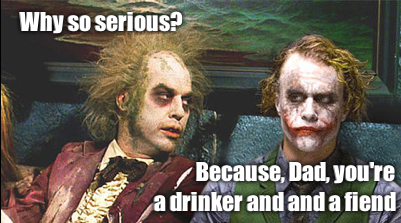
That awkward moment when Batman is actually the Joker’s father.


 CALEB COY