Red Letter Christians » Commendable in an Age of Short Cuts: Kings, Presidents and Prophets
No matter what anyone says, economy is a heavily moral issue. It is not a side issue.
Continue reading
Red Letter Christians » Commendable in an Age of Short Cuts: Kings, Presidents and Prophets
No matter what anyone says, economy is a heavily moral issue. It is not a side issue.
Continue reading
When you think of people who believe in nonviolence, what image comes to mind? Is it someone you find distaste in? Is something about them other than their commitment making you dislike them? Now picture someone who is like you or someone you admire in every way. Then imagine them truly believing in nonviolence. Would you call them a sissy? Coward?
In my last post I introduced the chapter-by-chapter review of A Faith Not Worth Fighting For, a collection of essays on Christian nonviolence, specifically questions often asked about it by skeptics, or just curious seekers.
The first chapter opens with a common misconception worded in this question: “Isn’t Pacifism Passive?”
We come to see that this argument against peacemaking has not roots in logic or theology, but comes from what I’ve found is a mixture of semantic misunderstanding and aesthetic distaste. In her essay C. Rosalee Velloso Ewell addresses this question very well.
[note: for the sake of clarification when I speak of pacifism I will speak of it in broad terms, meaning a commitment to nonviolence, which we will see is based on the word for “passion”. Whether that means a decision never to use violence ever, we shall see as we read along.]
As with the rest of the book, Ewell leads the discussion based on five assumptions for Christians:
1) Jesus and his story are real
2) We are to be witnesses of Jesus
3) We “see thru a glass dimly” (1 Cor. 13:12), but “we do see Jesus” (Heb. 2:9)
4) Faith is a journey in which we question ourselves and shine our light for others
5) It all goes back to the life (and death, and re-life) of Jesus
Continue reading
I will take away the chariots from Ephraim
and the warhorses from Jerusalem,
and the battle bow will be broken.
He will command peace to the nations.
-Zecheriah 9:9-10
I’ve been looking forward to reading a certain book for a while, now that I’ve had some friends recommend it to me. The book is called A Faith Not Worth Fighting For, a collection of essays about Christian nonviolence. It is a book that I already know will challenge me, will set the voice of scripture up against some things people sometimes tell me who also read that scripture a lot.
I’d like to thank Carl Jenkins for really getting me interested in the reading, and for giving me bits and pieces of his reading along the way. He did a book review. I’m doing a full chapter-by-chapter throughout the next month or so.
One of the lessons I’m going to teach my son one day is this: I have an apple and Mikey and Tommy both have an apple too, but they each want another apple. Joey has never had an apple and wants to try one, so I decide to give him mine. But Mikey and Tommy are big bullies, and Joey gets picked on, so if I give him an apple they’re just gonna take it away from him most likely. Tommy’s always been the bigger bully (at least that’s what Mikey always says), and so I might as well give my apple to Mikey instead of Joey because if I give it to Joey and Mikey and Tommy try to get it, Tommy might get it instead of Mikey.
What I’m going to teach my son is that it’s very important for me to give Joey my apple no matter what Mikey and Tommy say or do, even if I know they’ll take it away. Because there are four people who need to see it happen. What I will not teach my son is that giving an apple to Joey is the same as giving it to Tommy because he’s a big old bully.
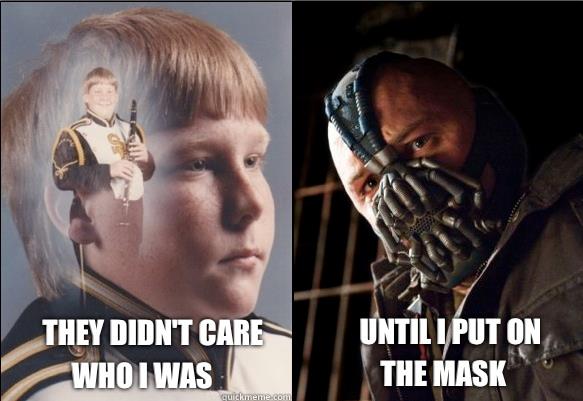
Last post I treated you to a Bane meme. Want some more?
Learn of Bane’s childhood. The untold story.
Real Life Hobbit Village Proves the Greenest Way to Live is Like Bilbo Baggins
A real life hobbit village. And it’s sustainable.
I remember reading an article in the St. Austin Review that described Tolkien’s Hobbiton as an embodiment of a social philosophy known as “distributism.” G.K. Chesterton was a big proponent of it. Wendell Berry—know him? You could call him one too.
It’s basically agrarianism where everyone is a peasant and nobody is a lord. In Hobbiton, all the farms are for sustaining the community, not trading with the outside world at large. The mill is the closest thing to an industry, but once again it is for producing enough for the Shire. “Distributists were ‘greens’ before anyone had the label,” and it certainly wasn’t because they worshipped the earth or anything. As Christians, they believed not that all creation was God, but that all creation was God’s temple.
As a teacher, I feel I need to come out and say now that I am not a shadow scholar. I do not write papers for students. I have never written a paper for a student.
However, once I did completely re-write a paper for a fellow student when I was in college. It was the summer, he was taking a marketing course online, he wrote a paper describing a plan to market and sell paper towels that “open easier” because there is an opening tear strip, everyone knew it’s easy to open paper towels by poking the top hole, and he had a lot to work on in terms of grammar and mechanics besides. So I completely rewrote his paper. The trade-off: He let me cleaned the lazer tag arena for me while I “edited” the paper.
We don’t really pay attention to Pat Robertson. Me and the people I know. Goobers that we are, we’re wise enough to know he is incapable of being trusted about anything remotely spiritual. In fact, one could create a guide on how to be a good Christian by merely saying, “don’t act like this man at all.”
But Pat Robertson isn’t Fred Phelps of Westboro Baptist. WBB is rather benign, since there is a small number of them and nobody takes them seriously. No, Robertson is much worse. He commands a media empire, and countless people look up to him. Professed Christians are looking up to a servant of Shaitan.
Three years ago, a fishy was terrorized by a terrible threat.
Now, see the fate of the second fishy. And this one has opposable thumbs.
 CALEB COY