“When the war ended, I don’t know if I was more relieved that we’d won or that I didn’t have to go back. Passchendaele was a disastrous battle – thousands and thousands of young lives were lost. It makes me angry. Earlier this year, I went back to Ypres to shake the hand of Herr Kuentz, Germany’s only surviving veteran from the war. It was emotional. He is 107. We’ve had 87 years to think what war is. To me, it’s a licence to go out and murder. Why should the British government call me up and take me out to a battlefield to shoot a man I never knew, whose language I couldn’t speak? All those lives lost for a war finished over a table. Now what is the sense in that?”
-Harry Patch, the last surviving veteran of WWI, who passed away in 2009

Continue reading
Category Archives: Peace
Electing Faithfulness Part 10: About 5 More Issues to Examine
[back to part 9: Education]
“And other issues to consider”
or
“Issues I may not care less about, but am squeezing together for time’s sake”
or
“Ok, Caleb Coy, let’s hurry up and wrap this thing up—I gotta vote in like 3 days.”
So, remember how I’ve been going on about Ron Paul because I’m writing his name in even though he’s not running? In this post I will get into things I disagree with him on, or am unsure about. This post will also cover other issues I have yet to mention. After this, I plan on having a final post to reflect on the whole experience before we all go and jump in those booths. It may be that I have a post after that to reflect on the results, and I already know that no matter what I will be reminding us all not to panic, because Christ will still be King when it’s all over.
Continue reading
Electing Faithfulness Part 8: The War on Some Drugs
[back to part 7: Healthcare]
“The War on Some Drugs”
or
“The War on Poor People Who Have Drugs”
or
“The War on Drugs Pharmaceutical Companies Aren’t Cashing In On”
or
“The War on Black People” (ok, that one’s harsh)
Take a brief look at what’s happening in America today:
Fully Armed Swat team shoots at ex-marine 71 Times in Marijuana raid—No Marijuana found
Marijuana raid kills father to be
And several other tragic drug war fatalities
In the simplest of terms, any substance that affects the body in a way that can impair a person is a drug, whether it be for medicine, recreation, or any other purpose. Thus, the term “drug” is a neutral term. However, we often hear about a so-called “war on drugs,” which is actually, if we apply it honestly, a war on particular drugs and for particular reasons, benefitting only particular people.

Electing Faithfulness Part 5: Swords<Ploughshares and The Golden Rule for Nations
[back to part 4: Economy]
“Swords Into Ploughshares: The Golden Rule for Nations”
or
“Bring the Boys Back Home” (if you really want to honor them)
or
“Can Rambo turn the other cheek?”
Ron Paul has an appropriate understanding of U.S. foreign policy, U.S. defense, and involvement in the Middle-East—far more appropriate than either of the candidates.

_A Faith Not Worth Fighting For_ Review: A Closure of Thoughts

“You can kill us, but you cannot hurt us.” -Justin Martyr
“The blood of the martyrs is the seed of the church.”-Tertullian
*Matthew 5:9; 5:38-45; 26:52; Luke 6:27-28; Romans 12:14; 12:17-21; 1 Cor. 4:12; 1 Peter 3:9; and Revelation 12:11
Having finished the book A Faith Not Worth Fighting For, I have one wish, that it was instead called A Faith Worth Not Fighting For. I think that phrase is more positive and more accurately reflects the essays within. The Christian faith is something I will fight for in my heart and in the endeavors of my faith, not with weapons, but with the piercing sword of the spirit that gives new life. Here the authors explain why they chose the title they did, which I think is justified.
Continue reading
_Not Worth Fighting For_ Review: Part 13
Chapter 12 was on the alleged violent Jesus in the temple.
Chapter 13 is about the alleged violent Jesus in John’s Revelation. J. Nelson Kraybill asks “What About the Warrior Jesus in Revelation 19: ‘He has trampled out the vintage’?”
To start with, Kraybill reminds us that “we should read Revelation as reassurance that God has chosen to act and redeem in the midst of a messed up world.” That’s important, considering some of the weird interpretations of the book that have come up over the ages. Far too many people still believe that it’s something like the “Left Behind” books that themselves left wisdom and truth behind. What John writes is in essence a revealing. In all the troubles Christians were undergoing and about to undergo, we Jesus is revealed. That is the purpose of the book John wrote on Patmos.
Continue reading
_Not Worth Fighting For_ Review: Part 12
The last chapter dealt with the centurion. This chapter deals with the temple incident.
John Dear in Chapter 12 asks, “Didn’t Jesus overturn the tables and chase people out of the temple with a whip?”
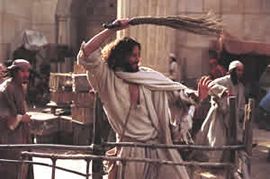
Most of the paintings of this incident were done after versions of the Bible were disseminated that translated the word as “whip”. Like paintings of a white Jesus, sometimes these old images continue through a culture, regardless of what a text says.
However, Dear makes it clear that this incident reminds us that “the nonviolent Jesus was not passive. He did not sit under a tree and practice his breathing.” Jesus was very confrontational, and may have seemed angry enough to hit someone or more. It’s no wonder we may think his actions at the temple prove he wasn’t nonviolent because it was so…action-oriented. “His nonviolence was active, provocative, public, daring and dangerous.”
Continue reading
_Not Worth Fighting For_ Review: Part 11
The last chapter discussed what Jesus meant by “bringing a sword”.
In Chapter 11, Andy Alexis-Baker looks at the case study of a Roman Soldier: “What About the Centurion?”
The argument has gone that since the centurion showed great faith, and that Jesus commended him, and did not tell him to leave the service, that it was ok for the centurion to be a soldier, and thus it’s ok for Christians to war.
But if you grew up with the heritage of faith that I did, you are very very familiar with how the whole “making arguments from silence” thing works. I’ve seen whole debates on whether silence is permissive or prohibitive (or either of these exclusively). Baker says “Jesus’ silence on the centurion’s profession has become a tacit endorsement of Christians becoming involved in state-sponsored killing.”
_Not Worth Fighting For_ Review: Part 10
The last chapter dealt with what it meant for “every soul to be subject to governing authorities“.
Chapter 10 Samuel Wells deals with a puzzling statement made by Jesus. Now we ask, “Didn’t Jesus say he came not to bring peace, but a sword?”
Matt. 10:34-39 is the central text in this chapter. Jesus did in fact say these words: “I have not come to bring peace, but a sword.”
The irony Wells points out is that nearly every Christian will tell you Jesus didn’t “come to bring the sword”, and yet so many Christians act as if he did, whereas he said he did “come to bring the sword”, and yet his life and the lives of his followers after his ascension show the opposite. So something’s strange here, right?

_Not Worth Fighting For_ Review: Part 9
Chapter 8 addressed the violence in the Old Testament and how we reconcile that with Christian nonviolence.
Chapter 9 deals with a single passage that gets abused quite a bit: “Let Every Soul be Subject”. Lee Camp tackles what this passage means in context, instead of in the absurd isolation in which it is often quoted, violently ripped from God’s word in order to serve agendas of violence.
If you read the entire passage of Romans 13, you realize that this one phrase was never meant to be a military mantra. We are to “present [our] bodies as living sacrifices” before God, and commanded not to “conform to the age” (often translated “the world”). Since we are a new creation, we live according to a new age. So whatever authorities we are under, they’re not ours.
Continue reading
 CALEB COY