What do people mean when they say Iran is a threat to global stability? Back in 2012 we called it “The Year Of Iran” because it was believed they would develop nukes. They still haven’t, to anyone’s knowledge. So if it’s not nukes, then what is the threat?
People never really say, but if you want answer, it’s easy to find. The Pentagon consistently makes it clear to Congress that Iran does not pose a real military threat to the U.S. or any other global power. Their military spending is lower than that of surrounding countries, and is gigantically eclipsed by U.S. military spending—to nobody’s surprise. Iran wouldn’t be likely to successfully invade anybody.
So why does Iran want nukes? Well, the real question is, why wouldn’t they? Like any nation that has nukes, they provide a deterrent strategy. The U.S. doesn’t like that, because Iran having a strong deterrent strategy means the U.S. is less capable of doing whatever we want in the region. Even Martin van Crevald, himself an Israeli military expert, has said it would be foolish of Iran not to pursue a nuclear arsenal as a deterrent. He knows this because Israel has nuclear weapons. And who else in the region does? Besides Israel? (Hint: the closest ones are a giant country that speaks Russian and a country next to India, who also has nukes, that rhymes with “Back is Tan”) And when the U.S. is in violation of UN charters, what country in that part of the world would trust the U.S.?
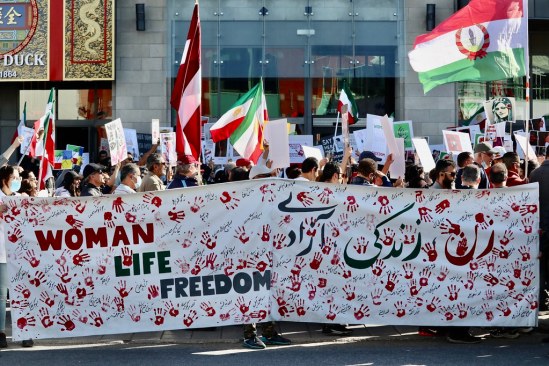
Well, what about the fact that Iran is an oppressive regime? Of course they are. That’s terrible. But the U.S. has plenty of allies that are domestically cruel. Yet they’re still U.S. allies. Even Israel, which is currently committing genocide in Gaza, is still a U.S. ally. It would be inconsistent to punish Iran or aid an ally of ours in punishing them simply because they have a cruel regime.
The irony of the U.S. involvement in the region is the insistence that Iran’s influence is labeled as “destabilizing” but U.S. influence is not. Look at our history with Chile. We love to “destabilize” countries in order to influence them in ways that are beneficial to us, and then call that “stabilizing,” even if it means supporting a brutal dictator.
Time and time again, regardless of the good or bad of a particular regime, the criteria for whether a nation is considered a threat is whether that nation’s sovereign actions interfere with U.S. interests. If a regime is also brutal, that helps pad the justification. If they want to obtain, or are rumored to have obtained weapons of mass destruction, this also helps the justification. But the only real criteria the U.S. government has ever cared about is our interests, primarily in natural resources—oil, mostly.
This has been the U.S. policy since, at the very least, WWII.
Much of the globe doesn’t care if Iran is able to enrich uranium. Why wouldn’t it be any country’s right? And any country that can also enrich uranium doesn’t have much of a leg to stand on when accusing another of being able to enrich uranium.
Name a country Iran has tried to invade. Name a country Iran has attacked in the past 50 years that hadn’t attacked them preemptively.
As a U.S. citizen, I am once again struck by the disingenuous attitude of my government in assuming its own role as “good guy.” When Turkey refused to support the U.S. invasion of Iraq, which has grown even less popular over time anyway, they were condemned. Turkey has more of a right to determine its relationship with its neighbors in the region than the U.S. does. But wait! The U.S. has the world’s mightiest military, and that military must be fed more oil in order to continue the work of destabilizing and rebuilding countries that have oil in order to get more oil to then guzzle up destabilizing and rebuilding countries with oil.
I despise Iran’s leadership. But this business of calling them a threat to global peace has grown tiresome. I have no wish to ever send Americans to be shot at there. If we send our citizens there with weapons, they will be shot at by people with weapons. It isn’t nuclear rocket science. And if it was, I would be about as much of an expert as Iran. Because they still don’t have weapons grade uranium.


 CALEB COY