
You probably know this is a photo of “the wall,” the most famous section of the Viet Nam war memorial in DC. It was designed by Maya Lin, a Chinese American architect. The purpose of the design was to create the image (when seen from above) of a giant wound, not a sign of victory, but a sign of hurt, of pain. Many people objected to this “non-triumphant” design, as well as the idea of an Asian designing it (even though Lin was Chinese and not Viet Namese, and by heritage only, having no prior allegiances to another nation). I can’t think of a more appropriate way to go about it.
Continue reading
Tag Archives: war
Is peace utopianism? War certainly is

Alexander Campbell, Tolbert Fanning, David Lipscomb: A Nineteenth-Century Anti-War Triumvirate
Alexander Campbell, Tolbert Fanning, David Lipscomb: A Nineteenth-Century Anti-War Triumvirate
Three early Church of Christ restoration leaders on war, peace, and the body of Christ.
All Veterans of All Wars From All Countries Are Welcome at the Table
“When the war ended, I don’t know if I was more relieved that we’d won or that I didn’t have to go back. Passchendaele was a disastrous battle – thousands and thousands of young lives were lost. It makes me angry. Earlier this year, I went back to Ypres to shake the hand of Herr Kuentz, Germany’s only surviving veteran from the war. It was emotional. He is 107. We’ve had 87 years to think what war is. To me, it’s a licence to go out and murder. Why should the British government call me up and take me out to a battlefield to shoot a man I never knew, whose language I couldn’t speak? All those lives lost for a war finished over a table. Now what is the sense in that?”
-Harry Patch, the last surviving veteran of WWI, who passed away in 2009

Continue reading
Electing Faithfulness: Concluding Thoughts
“Concluding Thoughts on Electing Faithfulness”
or
“Why should a foreigner like me care about this country?”
or
“I promise I’ll completely tone down the political postings for the next four years, but I ask that you to pay attention to this”
I am very much indebted the sermon I heard this Sunday by Frank Sullivan. It reminded me that Christ is our hope and that it’s foolish to place our “trust in princes” whose plans come to an end and who’s power is but dust to God.
Sermon on Christ as our Hope
Continue reading
Electing Faithfulness Part 5: Swords<Ploughshares and The Golden Rule for Nations
[back to part 4: Economy]
“Swords Into Ploughshares: The Golden Rule for Nations”
or
“Bring the Boys Back Home” (if you really want to honor them)
or
“Can Rambo turn the other cheek?”
Ron Paul has an appropriate understanding of U.S. foreign policy, U.S. defense, and involvement in the Middle-East—far more appropriate than either of the candidates.

_A Faith Not Worth Fighting For_ Review: A Closure of Thoughts

“You can kill us, but you cannot hurt us.” -Justin Martyr
“The blood of the martyrs is the seed of the church.”-Tertullian
*Matthew 5:9; 5:38-45; 26:52; Luke 6:27-28; Romans 12:14; 12:17-21; 1 Cor. 4:12; 1 Peter 3:9; and Revelation 12:11
Having finished the book A Faith Not Worth Fighting For, I have one wish, that it was instead called A Faith Worth Not Fighting For. I think that phrase is more positive and more accurately reflects the essays within. The Christian faith is something I will fight for in my heart and in the endeavors of my faith, not with weapons, but with the piercing sword of the spirit that gives new life. Here the authors explain why they chose the title they did, which I think is justified.
Continue reading
_Not Worth Fighting For_ Review: Part 13
Chapter 12 was on the alleged violent Jesus in the temple.
Chapter 13 is about the alleged violent Jesus in John’s Revelation. J. Nelson Kraybill asks “What About the Warrior Jesus in Revelation 19: ‘He has trampled out the vintage’?”
To start with, Kraybill reminds us that “we should read Revelation as reassurance that God has chosen to act and redeem in the midst of a messed up world.” That’s important, considering some of the weird interpretations of the book that have come up over the ages. Far too many people still believe that it’s something like the “Left Behind” books that themselves left wisdom and truth behind. What John writes is in essence a revealing. In all the troubles Christians were undergoing and about to undergo, we Jesus is revealed. That is the purpose of the book John wrote on Patmos.
Continue reading
_Not Worth Fighting For_ Review: Part 12
The last chapter dealt with the centurion. This chapter deals with the temple incident.
John Dear in Chapter 12 asks, “Didn’t Jesus overturn the tables and chase people out of the temple with a whip?”
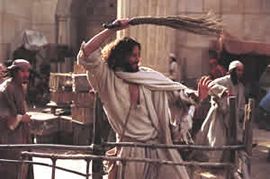
Most of the paintings of this incident were done after versions of the Bible were disseminated that translated the word as “whip”. Like paintings of a white Jesus, sometimes these old images continue through a culture, regardless of what a text says.
However, Dear makes it clear that this incident reminds us that “the nonviolent Jesus was not passive. He did not sit under a tree and practice his breathing.” Jesus was very confrontational, and may have seemed angry enough to hit someone or more. It’s no wonder we may think his actions at the temple prove he wasn’t nonviolent because it was so…action-oriented. “His nonviolence was active, provocative, public, daring and dangerous.”
Continue reading
_Not Worth Fighting For_ Review: Part 11
The last chapter discussed what Jesus meant by “bringing a sword”.
In Chapter 11, Andy Alexis-Baker looks at the case study of a Roman Soldier: “What About the Centurion?”
The argument has gone that since the centurion showed great faith, and that Jesus commended him, and did not tell him to leave the service, that it was ok for the centurion to be a soldier, and thus it’s ok for Christians to war.
But if you grew up with the heritage of faith that I did, you are very very familiar with how the whole “making arguments from silence” thing works. I’ve seen whole debates on whether silence is permissive or prohibitive (or either of these exclusively). Baker says “Jesus’ silence on the centurion’s profession has become a tacit endorsement of Christians becoming involved in state-sponsored killing.”
 CALEB COY