Last post I treated you to a Bane meme. Want some more?
Learn of Bane’s childhood. The untold story.
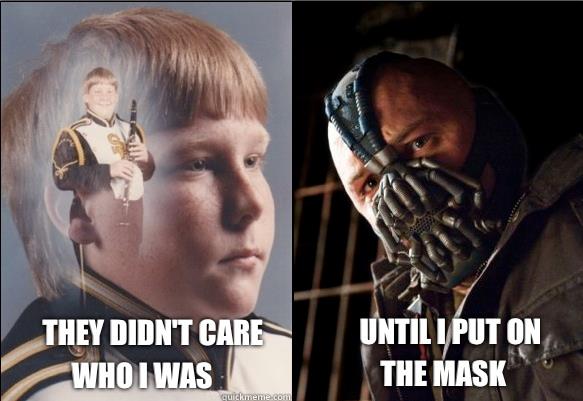
Last post I treated you to a Bane meme. Want some more?
Learn of Bane’s childhood. The untold story.
The Hunger Games movie is coming out on DVD tomorrow. I remember first hearing about the book. I’m like, “neat teens book idea. A little violent sounding.”
The idea sounded silly. Then I saw the movie. Then read the book. Then the others.
On the surface, the idea seems very profane. Kids killing each other. For entertainment. What has society come to? But if you read these books what you soon realize is that the book is using such a profane thing to ask questions about what entertains us, and what we are willing to embrace and accept, what we are passionate about changing and what lengths we will go to to make that happen, and what the consequences are of those lengths. And if you think that was a run-on sentence, then you see how oppression and violence can likewise run on and on and on, if we don’t do something to stop it.
I Am Sam is one of my favorite movies. In high school I dated a girl who I’m convinced only dated me just so she could see my impersonation of Sean Penn’s Sam whenever she wanted. It was really awkward and it didn’t last long. But my love for the movie remains.
It’s about a man with a developmental disorder who tries to raise a daughter alone. The problem arrives when she begins to grow old enough to surpass him on a developmental level. It is a bit of a sentimental morality play, but it has too many good moments to dismiss merely because it tries to convince us to believe in supporting a situation that is so borderline unfeasible it’s reckless: Are we really ok with a single father who has the development of a 7-year-old raising a child all on his own? But part of the question in the film is what it really means to be alone when you’re surrounded by people like you, and by people who care. And the entire soundtrack is Beatles covers.
Here’s one of my favorite scenes:
Continue reading
[I’ll tell you when the spoilers come. You’re good for now.]
I’ve been incredibly impressed with these Batman movies. I wasn’t a real avid comic reader as a kid, but they were part of my literacy experience. Comics aren’t just stuff for kids and nerds, but the hieroglyphics of our age. They’re fantastic stories with words and images that speak of the human condition. Maybe a thousand years from now people will think Comic Con was a pilgrimage to worship American gods. Ironically, though no sane adult would claim to believe these worlds are real, we do let them affect them as reality too often. Fiction and fantasy. Fun and fear. It can inspire. It can also reflect some of the worst in us.
The film is about revolution, about the livelihood of a city, a community, about the investments people make in a community, about the consequences of our decisions, or our lack of decisions. It’s about what happens when we hide the truth, when we hide behind masks, hide underground, hide in our money, our castles. It’s about punishment. It’s about redemption. About rising.

Remember that lion from Wizard of Oz? He was a big ol’ lion but he was a pansy. Then the wizard gives him a medal of bravery because he did, after all, face a witch and flying monkeys and the wrath of a fake wizard for Dorothy, even though he was scared. That time-worn, but true lesson that courage isn’t the absence of fear, but earning a fearless life by overcoming fear.
The first movie I watched after Noah was born was Courageous, the most recent film made by Alex Kendrick and Sherwood Pictures, the church group who made Facing the Giants and Fireproof (and Flywheel, which, if you see it, is really cheezy and low budget, but surprisingly compelling).
In Courageous, a group of police officers come to the realization that they aren’t living fulfilling lives as fathers. When they become dispirited from the growing rate of crime, they decide that the world needs fathers to step up and be more involved in their childrens’ lives. They make a pact together to be better fathers themselves.

Christian entertainment these days is full of cheese. It reeks of Andy Griffith and flannel board renditions of the parables. This isn’t necessarily a bad thing. Mostly it’s just a matter of taste. We don’t like to hear messages that are simple, or preachy, or brought to us by “an authority”. We like complex messages, stories that entertain us more than call us to action, and messages from characters that discover what they want, not come to a realization about what is right or wrong. Does this movie have cheese? It has some. But it’s not preachy, or oversimplified, or depicting Christianity as an authoritative religion.
The dilemma I find myself in is finding movies that are wholesome and artistically interesting and raw with meaning. We like our Andy Griffith, but it’s a story about a town that never really existed in real life (or at least exited for whites). It taught us really good lessons, but didn’t touch a lot of issues. But yet I’ve seen some movies simply because they were critically acclaimed and thought, “man, Clockwork Orange has a lot to say about society and the human psyche but did I really need to see all that?” I should have just read the book.
I say all this to say that I really enjoy and appreciate Courageous because it’s a wholesome story that doesn’t cut artistic corners or lie about how the world works. It is very much like the more popular film The Blind Side, only with much more overt Christian themes. Sure, some of the delivery is bad, but how shallow are we if we reject a message because the actors (who by definition are pretending anyway) aren’t as good at pretending as their more talented counterparts? Maybe that’s why good Christians aren’t good actors, because they don’t like to play pretend. Maybe non-fiction is more our thing, releasing documentaries about the good work being done for Christ. It’s easy to create wholesome entertainment for children, because they love to play pretend. For adults, maybe it’s hard to find wholesome movies because when we see people acting as Christians on the screen we see ourselves only pretending to be Christians.
Sherwood’s films do have their share of issues. [spoiler alert]. It sometimes seems that they’re trying to tell us that if we pray to God and try to do what’s right, bad things will stop happening to us. In Giants, the coach says “we win, we pray to God; we lose, we pray to God.” Well, they pray to God, and you can imagine what happens. I don’t think the filmmakers are trying to present the prosperity gospel, the great heresy of Joel Olsteen. After all, the scriptures say, “seek first the kingdom of God, and all these things will be added to you.” But the question is, does he give us everything we want? Or need? We need very little; fasting shows God we know this. I think the films try to show us that if we pursue faithfulness, things will come together in a meaningful way in our lives, whether for the good or in spite of it. In Courageous bad things happen, and even after the pact of faith is made bad things continue to happen.
Another critique of the film may be the very idea of these men taking an oath to be exemplary fathers, and having to have an ordained minister there to do this. I can see why people may be offended by this idea. Shouldn’t all fathers take up this mantle? Do you need a clergyman to verify your vow to be a good father? Since this idea is novel to the film, it’s not like they were trying to enforce some denominational rite.
What I do like about the film is something that could have gone wrong but didn’t: how they deal with crime and the world. Rather than a propaganda piece telling us that a rise in crime necessitates a rise in law enforcement measures at any cost, the writers propose that being better examples and leaders is the best solution. Of course, they still do their duty as cops to arrest criminals. But they also don’t show this simplistic view of crime and criminals. They prefer to tackle and handcuff than shoot. Judge Dredd is an anti-Christian figure.
They also avoid getting the racist label. Several of the criminals depicted are black, but, in the deep south this is a statistical truth that says more about race relations and poverty than “the black race”. One of the cops is black, too. One of the main characters is hispanic. He and his wife have deep accents, border on poverty, and are unemployed. This could have easily been a racist caricature, but it isn’t. They are portrayed as intelligent, hard workers with strong faith. Their accents are incidental, as is their poverty, and the man’s willingness to take any honest job makes himself honorable. In fact, he inspires faith in the white fathers. Some sensitive viewers might scoff at a comic scene involving the cops making use of his “hispanic-ness”, but that would be a stretch of a critique, and even then, even the heroes of a story aren’t perfect, nor should they be.
Bible belt Christians seem to be depicted as racist and, let’s face it, many are, and the white/black divide in churches shows there is still work to do. But I caught no signs in the film that the filmmakers were going to irresponsibly let their own viewers validate prejudice. They wanted to make sure their viewers didn’t walk away saying, “we would just have less crime if we just got rid of all this scum (meaning, certain ‘kinds’ of people).” The problem of crime isn’t the presence of a certain race or culture, but a certain value of honor and integrity, or lack thereof.
But I’m glad to see the rise in popularity of these films, even among non-Christian audiences. Hollywood just isn’t making wholesome movies any more, and even people who aren’t pursuing God are interested in wholesome stuff, not just for their kids, but maybe because deep down the know they need something uplifting and morally compelling beyond vague celebrations of “the triumph of the human spirit”.
I don’t think a film has to have an overt moral message to be considered “Christian”. But one thing I look forward to as a father is watching all this G and PG rated stuff that just doesn’t seem much fun without a kid in the house. I say that now—I’m sure I’ll sing a different tune after 26 viewings of Disney’s Cars.

 CALEB COY