_Not Worth Fighting For_ Review: Part 13

Chapter 12 was on the alleged violent Jesus in the temple.

Chapter 13 is about the alleged violent Jesus in John’s Revelation.  J. Nelson Kraybill asks “What About the Warrior Jesus in Revelation 19: ‘He has trampled out the vintage’?”

To start with, Kraybill reminds us that “we should read Revelation as reassurance that God has chosen to act and redeem in the midst of a messed up world.”  That’s important, considering some of the weird interpretations of the book that have come up over the ages.  Far too many people still believe that it’s something like the “Left Behind” books that themselves left wisdom and truth behind.  What John writes is in essence a revealing.  In all the troubles Christians were undergoing and about to undergo, we Jesus is revealed.  That is the purpose of the book John wrote on Patmos.
Continue reading
_Not Worth Fighting For_ Review: Part 12

The last chapter dealt with the centurion.  This chapter deals with the temple incident.

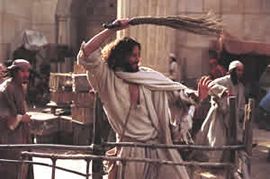
John Dear in Chapter 12 asks, “Didn’t Jesus overturn the tables and chase people out of the temple with a whip?”

Most of the paintings of this incident were done after versions of the Bible were disseminated that translated the word as “whip”.  Like paintings of a white Jesus, sometimes these old images continue through a culture, regardless of what a text says.

However, Dear makes it clear that this incident reminds us that “the nonviolent Jesus was not passive.  He did not sit under a tree and practice his breathing.”  Jesus was very confrontational, and may have seemed angry enough to hit someone or more.  It’s no wonder we may think his actions at the temple prove he wasn’t nonviolent because it was so…action-oriented.  “His nonviolence was active, provocative, public, daring and dangerous.”
Continue reading

_Not Worth Fighting For_ Review: Part 11

The last chapter discussed what Jesus meant by “bringing a sword”.

In Chapter 11, Andy Alexis-Baker looks at the case study of a Roman Soldier: “What About the Centurion?”

The argument has gone that since the centurion showed great faith, and that Jesus commended him, and did not tell him to leave the service, that it was ok for the centurion to be a soldier, and thus it’s ok for Christians to war.

But if you grew up with the heritage of faith that I did, you are very very familiar with how the whole “making arguments from silence” thing works.  I’ve seen whole debates on whether silence is permissive or prohibitive (or either of these exclusively).  Baker says “Jesus’ silence on the centurion’s profession has become a tacit endorsement of Christians becoming involved in state-sponsored killing.”

Continue reading

_Not Worth Fighting For_ Review: Part 10

The last chapter dealt with what it meant for “every soul to be subject to governing authorities“.

Chapter 10 Samuel Wells deals with a puzzling statement made by Jesus.  Now we ask, “Didn’t Jesus say he came not to bring peace, but a sword?”

Matt. 10:34-39 is the central text in this chapter.  Jesus did in fact say these words: “I have not come to bring peace, but a sword.”

The irony Wells points out is that nearly every Christian will tell you Jesus didn’t “come to bring the sword”, and yet so many Christians act as if he did, whereas he said he did “come to bring the sword”, and yet his life and the lives of his followers after his ascension show the opposite.  So something’s strange here, right?

Continue reading

_Not Worth Fighting For_ Review: Part 9

Chapter 8 addressed the violence in the Old Testament and how we reconcile that with Christian nonviolence.

Chapter 9 deals with a single passage that gets abused quite a bit: “Let Every Soul be Subject”.  Lee Camp tackles what this passage means in context, instead of in the absurd isolation in which it is often quoted, violently ripped from God’s word in order to serve agendas of violence.

If you read the entire passage of Romans 13, you realize that this one phrase was never meant to be a military mantra.  We are to “present [our] bodies as living sacrifices” before God, and commanded not to “conform to the age” (often translated “the world”).  Since we are a new creation, we live according to a new age.  So whatever authorities we are under, they’re not ours.
Continue reading

_Not Worth Fighting For_ Review: Part 8

In the last chapter Greg Boyd argued that God expects all Christians to “turn the other cheek,” but he may not necessarily hold nations to a standard only held within a covenant with him.

Chapter 8 begins the other side of the book.  Before, we looked at “practical” questions that apply scripture to situations.  The second half deals more with interpreting and understanding what scripture says on the matter, beginning with Ingrid Lilly’s question “What About War and Violence in the Old Testament?”

Continue reading

_Not Worth Fighting For_ Review: Part 7

I remember one time we were with some friends watching How to Train Your Dragon with some friends who had children.  I said, “I wonder if there’s some critics who say this film is bad because it’s telling us to love terrorists or something.”  The guy said, “yeah, can you believe people actually believe that?”  I think he meant the loving terrorists thing.  Of course the whole point was that the dragons weren’t the real enemy, but the monster they were serving.  So is there a kind of person we are not called to love?

While the previous chapter focused on soldiery, in chapter 7 Greg Boyd asks, “Does God Expect Nations to Turn the Other Cheek?”  We actually may be surprised by his answer.  I had previously read Boyd’s book The Myth of a Christian Nation, a terrific read that asks us to reconsider the naive notion that America is “Christian” in any tangible sense, by looking at scripture.

He reminds us that Jesus’ instructions are unconditional, and that God has even the worst, most violent of our enemies in mind, not just meanies down the block, in Matt.5:38-48; Luke6:27-36; Rom.12:14-21; 1 Peter 3:9,14-18.  Imagine, he says, that Al Qaeda ruled America, and you will know the animosity the Jews felt toward Rome.  But since what Jesus did for isn’t just what he did, but reflects what he wants us to do (be willing to die innocently loving our enemies and not harming them), Christians don’t have the right to choose who they will and won’t love, will and won’t show loving action toward.
Continue reading

_Not Worth Fighting For_ Review: Part 6

“They triumphed over him
by the blood of the Lamb
and by the word of their testimony;
they did not love their lives so much
as to shrink from death.” -Revelation 12:11

“So if the Son sets you free, you will be free indeed.” -John 8:36

Happy International Peace Day, everyone.  A day we should all celebrate.  In part 5 of the review we looked at the difficult question of how to be or work with policing in a peace community.

Chapter 6 is a message easier for me to accept up front, and is a conclusion I have already drawn.  Justin Bronson Barringer asks, “What About Those Men and Women Who Gave Up their Lives so You and I Could Be Free?”  A question which he feels “seems an attempt to shame the one to whom it is directed as one who dishonors soldiers.”  As if to say that the people who don’t love soldiers are the ones who want them to come home, not the ones who want to send them out to shoot and get shot on the sender’s behalf.

Continue reading

_Not Worth Fighting For_ Review: Part 5

The last chapter dealt with Hitler.

Chapter 5 deals with a question we might often overlook: “Must Christian Pacifists Reject Police Force?”

One reason it’s overlooked is that, until 200 years ago, military and police weren’t really seen as separate entities in most of the world.  They are both government agents authorized to use force, and even violence, if necessary.  The distinction remains important because, unlike war, police can truly “be accountable to legislative regulation” that “at least stands some chance of punishing only the guilty while protecting the innocent.”

In this chapter Schlabach first introduces the concept of nonviolent policing, which some people may regard as a joke.  How are police effective if they don’t use force?  But the same question could be asked of soldiering, perhaps.
Continue reading