Room 60: Conspiracies, Bureucracies, and Hospital Mgt.
[see previous post on illiterate law enforcement]
—I brought you in for a topic that frustrates me as much as it does the protagonist.
—Fair enough.
Continue reading
Room 60: Conspiracies, Bureucracies, and Hospital Mgt.
[see previous post on illiterate law enforcement]
—I brought you in for a topic that frustrates me as much as it does the protagonist.
—Fair enough.
Continue reading
Room 57: Illiteracy, Profiling, and Cops [see previous post on morals]
—I know you’re tired of people picking on cops, but we have to interrogate you too.
—Asiomerican lives matter. Carry on.
—There’s a bit from when Thomas is talking to you and he has this theory that the reason you shot his friend was because “you and your buddies can’t read.”
—That’s right. Kind of an unfair charge directed at a cop.
—I think he has a point.
—That we’re a bunch of ignorant redneck bullies?
Continue reading
Room 54: Morals, Principles, and Pederasts [see the previous post on Promises]
—This is embarrassing. Do I have to do this again?
—Yes. This is your punishment, pederast. Let’s talk about gray areas.
—I know where this is going, and I don’t want to go there.
Continue reading
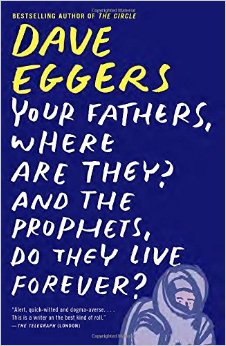 Your Fathers, Where Are They? And the Prophets, Do They Live Forever?
Room 52: Fathers, Prophets, Astronauts and Promises
[So you’ve read Your Fathers, Where Are They? And the Prophets, Do They Live Forever? by Dave Eggers. SPOILERS AHEAD! Beginning with this post, Caleb Coy will interview each of the 7 kidnapped characters in the novel and interrogate them on the book’s themes.]
Continue reading
“Moby Dick is a monstrous fable, or still worse and more detestable, a hideous and intolerable allegory.” -Ishmael, Moby Dick
“To produce a mighty book, you must choose a mighty theme.”
-ibid.
Continue reading
The following are selected passages from An Authentic Derivative, my debut novel. These select passages are provided courtesy of the author, for your convenience. Mine them for what you wish, but only the novel can give you the full experience of the story as told by narrator Neil Oberlin.
Continue reading
Conclusion and Reflection
Many current critics will argue that the Gospels are obstacles to understanding the historical Jesus, but I believe they are the means. I think what plagues many modern scholars is a distrust of the past itself, an almost disdain for people of the past. We live in an “enlightened” age in which we seem to almost study all the horrible things in the past—colonialism, slavery, sexism, war, ignorance, oppression—as if looking for little happy things that stand out because they are like the values we have today. In this way I think most current historians and textual scholars dismiss the Scriptures. As Bauckham quotes Coady,
“The independent thinker is not someone who works everything out for herself, even in principle, but one who exercises a controlling intelligence over the input she receives from the normal sources of information whether their basis be individual or communal.”
Continue reading
Testimony invites trust.
Continue reading
If we can’t trust memory, we can’t trust anything. As Bauckham says, “trust in the word of others is fundamental to the very idea of serious cognitive activity.”
Continue reading
As with our friend we studied with, we had grown up simply weaned on the idea that since the Holy Spirit directed the writing of the Gospel, God just straight up told each writer what to write word-for-word. This doesn’t explain, for example, why Luke tells Theophilus that he himself researched the Gospel accounts before writing his. So the idea of defending scriptures by appealing to them being well-researched by their authors was actually somewhat new to me. Instead, I was used to them being defended on the grounds that proof of their accuracy was direct proof of their divine origin, regardless of any research done into the story.
Continue reading

