Last month we had Passover and Easter. We also had Holocaust Remembrance Day. We also had an announcement about a big Marvel film. We also had some significant events happen at Harvard.
This all brought to mind something I’ve been thinking about, and it has to do with a famous comic book character.
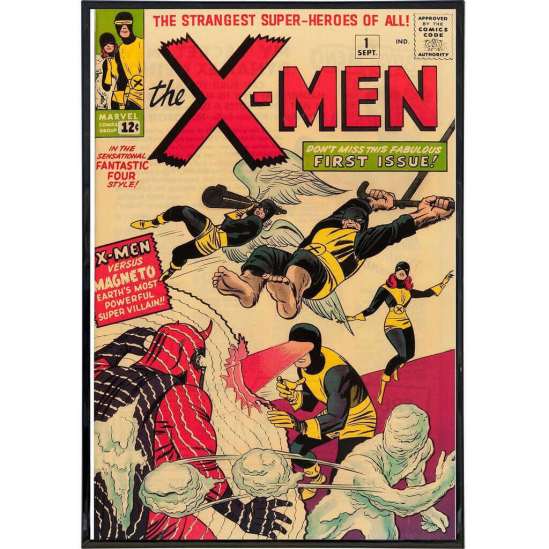
The image on the right is of the first X-Men issue. You might recognize the characters. You’ve got Angel, Beast, Jean Grey, Cyclops, and Iceman, all facing off against the famous villain, Magneto.
There are many layers to this comic, one of them being that you have five people fighting a Jewish character. If I were to only tell you this layer, you might ask a particular question: Is this comic anti-semitic? You have this really bad guy, and he’s Jewish, and these people are attacking him.
But this is just one layer of what’s going on here. In fact, Magneto, and the other X-Men, were created by two of America’s most famous comic book artists, who were also Jewish. (Oh, and Ice-Man is also half Jewish, and Kitty Pride, who is not in this issue, is a Jewish member of the X-Men as well.)
Stan Lee and Jack Kirby were two Jewish Americans who’d already created famous comic characters when they came up with the X-Men. Tired of drumming up new origin stories for characters, they found a simple solution: a world where people are born with powers. Hence, mutants were born.
The X-Men have become a staple pop culture analogy for various issues, usually taking a progressive stance toward inclusiveness for racial minorities, sex and gender minorities, disability groups—you name it. In this world there are humans who vastly outnumber born mutants, who if they banded together could overpower all humans. On both sides are heroes and villains. It’s a complex world where good and bad are not defined by your genes, appearance, or ability, but by your choices.
Magneto is famously known as a supervillain who is also a Jewish survivor of the horrors of German concentration camps. He vows “never again” and dedicates his life to protecting himself and his kind at all cost. However, Magneto’s self-identifying kind turns out to be mutants, and homo sapiens (non-mutants) are the enemies he’s bound to protect his kind from. The thing is, Magneto is proven 100% right that humans are a threat to mutants. It’s his methods that get out of hand. To exemplify the villainy of his stance, we have the contrast of Professor X.
In the 70s, Magneto and Professor X were re-designed by Chris Claremont, who had spent time working with holocaust survivors in an Israeli settlement. He modeled the hero and villain after two very different prime ministers of Israel.
Throughout the years, Professor X and Magneto have demonstrated, among other conflicts, the debate over how a vulnerable minority group can use the power it does have to protect its own interests. If Spider-Man is about a man taking great responsibility with great power, X-Men is about identity groups doing the same.
Professor X believes it’s possible for humans and mutants to live in harmony, even though it takes great work and sacrifice, standing up for others, being disciplined and understanding. Magneto takes a cynical approach: Mutants are actually better, and should rise to rule the earth, or perish in the hands of lesser humans. More often than not, Magneto sticks to his guts, though sometimes he joins the side of good, and sometimes the professor makes morally questionable choices well.
Thus, Magneto has come to represent, for Jewish readers as well as others, the temptation to turn the “never again” oath into an excuse to carry out the same kinds of atrocities that were thrust upon you. Just as a person who was bullied as a child could choose to bully others, a society who faced terror could choose to commit terror. Surviving atrocity is no guarantee that you will never commit atrocity. The choice is still yours, and in fact for some people the choice may be difficult. Trauma can radicalize people. For some breaking the cycle might come easy, but for others it can take courage and hard-won trust.
So, back to the original question. Is a Jewish bad guy in the X-Men comic anti-semitic? While some have taken that view, most critics, including Jewish ones, see Magneto as an important and morally complex character who represents an important moral quandary for vulnerable people. For example, when a religious-ethnic minority is granted a new state in which to live, what powers do they now have that displace other vulnerable people? And what will we say or do to justify displacing others to protect ourselves?
When we look at all the layers, we see the moral complexity and even delicate treatment given to this iconic character. Magneto was created by two Jewish artists and also given a makeover by someone who had worked with ideologically diverse Jews. And a few of the X-Men are also Jewish. The overall arch of most X-Men stories refuses to allow us to treat any minority as inferior. Magneto has motives we can sympathize with, he has human feelings, and has sometimes joined the side of good.
If anything, I’d say that part of the problem is that Magneto’s mission means he is erasing his Jewishness. In the story, he is usually put in the camp before his powers are known, yet when he emerges with his powers he kind of rewrites his own history. He identifies as a homo superior, not a homo sapien, and his powers make him superior to all homo sapiens, including Jews who are not also mutants. In the film X-Men: United, he even tries to commit genocide against all non-mutants, which would include most of the Jewish people on earth. I think there’s an important lesson there. Our commitment to an ideology can actually erase our roots, and we can go against the very thing we were meant to be.
Back to the comic. If I present it to you and tell you that the guy in the bottom corner is Jewish, and that’s all you know, you might be led to believe that the comic is anti-semitic propaganda telling you that Jews are bad and we should gang up on them. In reality, far from it. Anti-semitism is real, as the comics attest to in Magneto’s origin story. In fact, the atrocity he went through helped create him, which goes to show how evil can duplicate itself by radicalizing its victims.
I won’t go into telling you how to apply these lessons to current events, but I will say that when X-Men was created, the state of Israel was very new, and we are still dealing with the same basic issues as we were then. Jewish people have a right to protect themselves. Palestinians deserve the same. And if we’re not careful, we can misuse the past to abuse the present. But if we want to honor our own identity, I think it’s important to acknowledge that identity is manifold, and the dynamics of power aren’t always as simple as they’re laid out in a single story.
Let’s work to create a better world where people can live together.
 CALEB COY